

Two lines,one powerful identity.
Three watches placed side-by-side,all direct heirs to the same horological revolution.
Three variations of the Royal Oak family which,since 1972,have consistently affirmed that design can become iconic.
The first watch to examine is the fake watches Royal Oak“Jumbo”Extra-Thin ref.15202ST.
In its steel version,with a blue“Petite Tapisserie”dial,date at three o’clock,and a 39 mm diameter,it embodies the pure expression of the original concept.

In 1972,when Gérald Genta designed the octagonal case with eight visible screws and conceived the integrated bracelet,few could have foreseen that it would be the first luxury sports watch in steel,a bold move on the metal then relegated to the realm of tools.
Even today,the 15202 remains one of the most faithful heirs to the ref.5402:brushed steel,slim profile,assertive presence.
It exemplifies the language of line,construction,and visible finishing.
The Royal Oak Perpetual Calendar ref.26574OR in rose gold(blue dial)reflects what the manufacture did next:
Deepen the concept,enrich the mechanics,without abandoning the original design codes.
The case retains the octagonal shape,the integrated bracelet,and the”Grande Tapisserie”guillochépattern,but the complication is now on full display:

Day,date,month,week,moon phase–everything is legible,symmetrical,and boldly presented.
When the first Royal Oak Perpetual Calendar appeared in 1984,it marked a turning point:combining iconic design with high complication.
Then,the 26574 model,launched in 2015,adapted the diameter to 41 mm and introduced the caliber 5134,a complete and revisited version of the historic 2120/2800 movement.
This model demonstrates how the Royal Oak has not simply repeated its history but has elevated it.
Finally,the third watch,the Royal Oak Perpetual Calendar ref.26574ST in steel,also with a blue dial,confirms that steel is no longer the exception but the obvious choice,even in high complications.
By presenting the complete complication in a steel version,Audemars Piguet demonstrates that technical excellence and design can coexist in the same material.
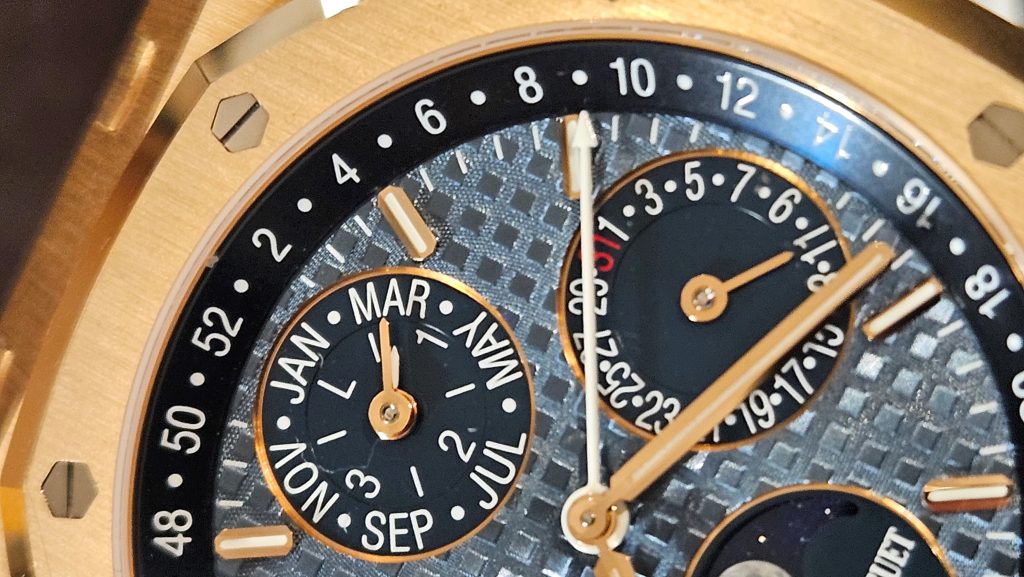
The 41 mm case,the thickness of less than 10 mm,the integrated bracelet:
Everything is designed to ensure that the shape is instantly recognizable.
These three watches,taken together,tell a clear story:
The Royal Oak is first and foremost a bold design,a radical departure.
It then becomes a testing ground for horological innovation,and finally a manifesto of style and technology accessible to a wider audience—at least within this elite segment.
The core remains the same,but the watch evolves.
The metal remains the same,but the complication takes center stage.
The integrated bracelet remains the architecture of the wrist,the guillochépattern remains the visual signature that inscribes the watch in history.

A close examination of these three pieces cannot fail to reveal the continuity:
The octagonal bezel framed by screws,the polished and brushed edges.
The”Tapestry”pattern on the dial,the integrated monobloc bracelet—all testify to a deliberate choice.
A choice that is one of presence.Unlike watches that seek to blend in,the Royal Oak demands to be seen and recognized.
The perpetual calendar in steel elevates this demand to the level of the complication.
And the rose gold gives it a warmer,almost baroque tone,without compromising its original structural rigor.
In 2025,these three references carry with them the weight of history—but also the legitimacy of the present.
They demonstrate that enduring a design does not mean freezing it in time,but rather keeping it alive.
And it is precisely in this tension between continuity and invention that the charm,intensity,and prestige of the Royal Oak reside.
Author

Related posts

Audemars Piguet CODE 11.59 Collection Fake Watches
The famous Swiss watch brand Audemars Piguet has unveiled a groundbreaking collection called Code 11.59 by Audemars Piguet. The key design element...
Read out all
Modern Luxury:Audemars Piguet Royal Oak Replica Watches Uk
The Audemars Piguet Royal Oak is one of those watches that every watch enthusiast,if not a fan,should at least get to know...
Read out all
Replicas Watches Audemars Piguet Royal Oak Perpetual Calendar
There had been rumors that the Le Brassus manufacture was going to release a new Perpetual Calendar in ceramic due to the...
Read out all
New Audemars Piguet “The Beast” 43mm Replica Watches
A complete overhaul of“The Beast”with a new case,new dial and new movement. 2021 and Audemars Piguet presents a major update to the...
Read out all
The History Of Audemars Piguet Watch Replicas Uk
Audemars Piguet is one of the increasingly rare watch brands to celebrate a centenary while still being owned by the same family....
Read out all
Audemars Piguet Sapphire Orbe Replica Watches Uk
The Le Brassus manufacture,renowned for the quality of its watches and especially for its Royal Oak collection. Presented a piece at the...
Read out all